Sunday, 2 June 2013

The FUTURE and bye-byes

-->
The Future of Social Media

(http://24.media.tumblr.com/tumblr_mdawbvKe141qzxhn2o1_500.png)

Over the past eight weeks here on Social Ramblings, we have looked in depth at the power of social media in twenty-first century. When thinking about social media, it is ever too easy to dismiss the term as something as simple as Facebook or Twitter. However, just as I have discovered, and I hope you have too, social media is so much more powerful of a tool than a way to tell your friends what you’re up to.

(http://data.whicdn.com/images/42735101/490610953126330107_7UvE2cyx_c_large.jpg)

Social media has actually been around for a lot longer than you might think. Remember ICQ? I can’t. It was old instant messaging system for desktop computers created in 1996. My parents told me they used it when they first got the Internet, back in the old dial up days.


(http://24.media.tumblr.com/tumblr_mazaqwwWES1qev6e9o1_500.jpg)

 I don’t think anyone could have imagined the impact that social media would have on society; for many of us, it dictates our lives, with our popularity and self worth being based off how high we are rated or ‘liked’ online. But we discussed this when we looked at mobile devices. Society already posts so much about their lives online, with not a whole kept secret; where will that leave society in future?
(http://data.whicdn.com/images/62494581/large.gif)
(http://data.whicdn.com/images/2018489/tumblr_l11wcw7K8M1qz76r7o1_500_large.jpg)
 The first thing that springs to mind is that society will continue the trend in expressing more and more about themselves, until there is no difference between our online and offline selves. But after thinking more deeply, I think that society will become even more selective about what they put online. Employers are now notorious for checking out potential employees online before even asking for an interview; society will be so very careful with the image they construct online of themselves. This links with the discussion on online identities, we are able to construct any image we like of ourselves online relatively easy, there’s nothing stopping anyone from constructing the perfect candidate image online. 

 (http://facebookcraze.com/wp-content/uploads/2011/04/funny-facebook-profile-pictures-truth.jpg)

I also believe that society will become even more self-conscious about how popular they are perceived to be online. This in turn will lead to more politicians using social media as a tool to measure their popularity and try to ‘connect’ with younger generations. 

 (http://25.media.tumblr.com/ab96b1d7bf29fcd1720b4423024246c3/tumblr_ml8y5j7qGN1s66gldo1_500.png)


If you have time look through this photoset on Tumblr about Kevin Rudd's social media tactics, good fun.

When thinking about the future of social media it can lead us to believe that soon, society will be doing everything online; we just have to remember that some experiences are best kept offline.
 (http://web-images.chacha.com/images/Gallery/4843/what-are-the-best-e-cards-about-working-out-355937455-oct-9-2012-1-600x420.jpg)

This will be the last post on Social Ramblings; I hope you’ve enjoyed your stay. Blogging has been a really fun way to express ideas about anything with the world. And although it can be a bit controversial at times (see Extremists and anti-corruption) it gives anyone with Internet access the potential ability to reach as many people as well known scholars, politicians and celebrities. 

(http://data.whicdn.com/images/36949763/tumblr_m2ahb0LGsf1r4u9wdo1_500_large.gif)  
Thanks for sticking around for my ramblings,

-Carla.

Monday, 20 May 2013

EXTREME!-ists

The Internet is great in bringing people with like-minded thoughts and opinions together, giving them a platform to express their shared love. If you’ve ever used Tumblr, that’s pretty much half of it-people all fangirling over their favourite tv shows or movies. 


(http://data.whicdn.com/images/38370651/tumblr_mao8wn28VR1r6r7t1_large.gif) (https://si0.twimg.com/profile_images/3254735848/f85a07143b1c4fd1cd419ab8f2c3220d.jpeg)

But there is a dark side to this- just as people can join together to discuss their love of my little pony, they can just as easily join together to form hate groups, and find people with like minded hatred. Hate groups have expanded from small domains on the Internet to pages on social media sites such as Facebook.  By incorporating hate groups on social media it makes it easier than ever for people to join and to target potential members.

I personally have seen a number of ‘hate’ groups pop up on Facebook recently, a ‘Cancer is funny because people die’ one pop’s to mind. It’s hard to tell through online hate groups if people are being serious with their claims or are simply trying to cause a stir and make people angry. 

(http://images.wikia.com/fantendo/images/3/3e/Troll_Face.png)

Extremist groups are “any ideology or political act far outside the perceived political centre of a society; or otherwise claimed to violate common moral standards. “ This means extremist groups can be a part of a registered political party. Take the Australia First Party for example. The Australia First Party is an extreme right wing political party, (making it extremist) whose policies including limiting immigration and abolishing multiculturalism.  Besides having their website made using  Comic Sans
(how can anyone take anything written in Comic Sans seriously?) 

(http://25.media.tumblr.com/tumblr_luvdkkb3ca1qj6xzto1_500.gif)
(http://chic-type.com/blog/wp-content/uploads/2012/07/comic_sans_2.gif)

My face exactly when I see Comic Sans.


No.

The Australia First party has failed to make any huge impact online, with just over 200 likes on Facebook. 
(http://www.australiafirst.net/graphics/logo01.gif)
(http://www.fightdemback.org/files/images/pylstickersepping5.jpg)


Howard Rheingold has a utopian view of virtual communities and the way they benefit our lives.  This allows people from across the world to share their views without ever leaving their house. This aids in the creation of hate groups because your privacy is protected. The community and the people around you are unaware of what you are up to or what you are supporting, you can easily find people with similar extremist views that may not exist in your community.

Personally, I can only see the dark side of social media growing in the future. Society as a whole is becoming more and more desensitised and more hate groups will emerge as people ‘like’ them as inappropriate jokes. Extremist political parties will continue and increase their presence on social media to recruit members. Social media means people can have secret identities online and cannot physically see the people they are offending, making it all the easier to do so.  
(http://www.opednews.com/populum/uploaded/hate-22149-20130102-617.jpg)

Sunday, 12 May 2013

Catfish


Online we can be whoever we want to be, there are no barriers stopping us. There’s this really interesting documentary called Catfish about a young man who meets a family from across the country online. (Spoiler alert!) After a nine month relationship he discovers the family he knows are not what they seem -all the family and friends profiles in which he’d been interacting with, including the nineteen year old girl he fell in love with, were all run by the same person, a middle-aged woman. You can never be one hundred per cent sure with what you’re getting online, and whether that be with a potential girlfriend or eBay purchase you should always be weary.  

(I may have just watched Catfish and wanted to link it somehow, this is my blog, I make my own rules.)
(http://blogupnorth.files.wordpress.com/2011/05/online-personality-real-life-personality.png)

 If we think of virtual communities (and the creation of them) we are likely to think about programs such as The Sims or Second Life. Where you able to create a world, create yourself and interact with those in it. Programs like Second Life in particular aren’t just about replicating consumer societies with a better-looking version of yourself as an avatar; it’s about reinventing yourself completely. You can be as controversial, confidently or slutty as you like because in the end nobody really knows who you are, and if that personality doesn’t work out, it’s all too easy to reinvent a new one. Through these virtual communities we are able to be everything we’re too afraid to be in the real world and experience society differently. (Just like the woman in Catfish was doing, it links!)
(http://data.whicdn.com/images/1364637/tumblr_kwk0dvEdyJ1qa018eo1_500_large.jpg)

Jean Baudrillard discusses the idea of Hyperreality as something where users are unable to distinguish between true reality and created simulations of this. But in Baudrillard’s discussions he explains how users are able to blur the lines so far between reality online and offline that they start to create symbols and meanings for things that don’t actually exist. When I think of this, I think of popular games such as Farmville, where the user knows they gain no true value from playing in the real world, but lose sleep, time and real money playing to gain a status symbol that means nothing. Rheingold explores how wonderful virtual communities can be. How they surpass time and space limitations and help make our lives better. Virtual communities are great, I often wonder how many of my friends I would still speak to if I wasn’t on Facebook; but I think virtual communities aid in the creation of hyperrealities, where now friendships stay alive by the mutual like of posts.    

(http://data.whicdn.com/images/7753094/tumblr_lhnp5mhfP91qddkxxo1_500_large.png)

I guess the dying question is ‘will we all end up living on second life?’ and I say no. Nothing beats human interaction, the feeling of physically being around people and having real world experiences. However, new innovative products such as the Durex ‘Fundawear’ (underwear for long distance lovers, that allows each pair to feel touch through an app –watch the video) make it seem as if physical real world reactions will slowly fade away.
We are now able to shop, work and study online; things we never dreamed of years ago. It does leave us wondering where the future will take us, and how far it will surpass our wildest dreams. 
(http://data.whicdn.com/images/60126885/large.jpg)

But who knows really...

Wednesday, 8 May 2013

No, I read it on Wikipeida. It's true.


Produsage 


 (http://data.whicdn.com/images/33311621/tumblr_m7nkferJEQ1qb6t6wo1_500_large.gif)

Like we’ve discussed here before on SocialRamblings the Internet has made it easier than ever for society to achieve things. You no longer need to have a high degree in order to write for an encyclopaedia, no, all you need is Internet access. Wikipedia anyone? 

(http://data.whicdn.com/images/60750186/large.jpg)

This user lead content creation we all use today is called produsage. Wikipedia is one of the best and most well known examples of produsage in today’s society. Anyone with Internet access, educated or not, are able to add to and edit the worlds largest encyclopaedia, and for the most part it works. I don’t know anybody who doesn’t love Wikipedia. If a science-y article is too wordy to get your head around, try Simple Wikipedia. Produsage allows the consumer to become the producer and the resulting product is therefore what the consumer wants. It’s all the relevant information in one place, with easy to access links to related topics and references. Perhaps the best merit of websites like Wikipedia are the ease in which the information can be updated. If a new law has passed, record has been reached or a celebrity wins an award that information can be changed immediately. There’s no more waiting for a new edition, its there almost instantly. 

(http://data.whicdn.com/images/37878509/tumblr_manrfsi72M1rd9rg0o1_400_large.jpg)
 
The ease in which produsage allows anybody contribute may however, be its biggest flaw. Anyone can contribute anything, doesn’t mean that everything they contribute is going to be right. You can’t measure how much a user truly knows about a topic by their contributions, most of the time, if its there, you sort of believe it. Melbourne Comedian Dave Thornton acknowledges this, and makes jokes suggesting that each user should be given a specific font based on their intelligence level, a doctor, Times New Roman, an idiot, Wingdings.
Everyone’s heard of or seen something on Wikipedia that’s not right; some are more obvious then others. It’s a new age problem with produsage. Giving everyone access gives anyone the opportunity to change the program for better or worse. This may lead to an overall distrust of the system or program. Every teenager has heard (and ignored) their teachers tell them Wikipedia is not a reliable reference. 
(http://data.whicdn.com/images/49926135/6379663_700b_v1_large.jpg)


Wikipedia isn’t the only source of produsage on the Internet. Blogs and YouTube videos count too. It’s user based content creation. The parody’s and reviews all create a web of discussion, where users are able to post and explore their responses. This fits in with Henry Jenkins views on participatory culture. Participatory culture is essentially produsage. In participatory culture members contribute together and feel as if their contributions are both valued and important. Participatory culture also strongly supports creation by others. If you think about popularity of websites like YouTube that’s what you’re finding. A web of people, creating their own content and sharing it with the world.  
 
As for the future of produsage? I can’t see it slowing down. I think produsage will only continue to get bigger and bigger and fill more spaces online. 

 (http://sharkrobot.com/images/medium/shirt_kingdomarts_internet_MED.jpg)

Tuesday, 7 May 2013

The one about trying to be young and hip


Social Media and politics

What is the best and easiest way for old people to seem young and hip and connect with young people?  Through social media of course.

(http://cdn.ientry.com/sites/webpronews/pictures/oldfunnytongueguy_616.jpg)
 
This is the strategy enforced by many politicians in their endeavors to reach and connect with younger audiences. The way in which it allows society to watch media releases and learn about candidates in their own time, makes it seem as if this is the way of the future. 
 
(http://24.media.tumblr.com/c3e7195cebd935c5c45665734222616c/tumblr_mmc06aFP6W1qelkf9o1_500.jpg)

If the increase in popularity of social media in politics continues it will change the way society views its candidates. Old-fashioned principles and methods will no longer stand as viable options in social media; nobody wants to watch a half hour speech about a policy, its boring and doesn’t fit into our online attention spans. In social media, we need things to not only be capturing our attention away from the other million things the internet has to over but quick and easy to watch, read or follow. Ex Australian Prime Minister John Howard is an excellent example of poor social media tactics. His YouTubevideos are long, uninteresting and did not attract views. Howard and his team in charge of social media did not try to use their media platforms to their full abilities.
But even if they did, it raises questions if it was even possible for Howard to be popular on social media due to his traditional, conservative demeanour. Just like everyone else on social media politicians need to be stand out, individual, easy to understand and humorous in order to be popular online. US President Barack Obama has truly mastered this. He appeals strongly to a younger generation due to relevant presence on social media. 
(http://data.whicdn.com/images/56900740/tumblr_mkeizklUDM1rn7mcfo1_500_large.jpg)

 Obama (and his people, more likely) use social media in the appropriate ways for each platform. Tumblr is my favourite example of this. Tumblr is an interesting form of social media; it’s not a typical wordy blog, you reblog (or share) things you like (mostly images) and its very light hearted and fun. Obama uses Tumblr is this way. His blog is light hearted. It’s informative but its still fun. It seems as Obama (‘s people) is using his Tumblr just like everyone else is, making him seem very connected with his audience. This contrasts to Obamas opponent Mitt Romney whose Tumblr blog falls on the more serious and political scale. There are no ‘fun’ posts; it is a blog purely run for a political purpose. Obama’s Tumblr is has been created to make himself appealing to the Tumblr audience, and it works.

(http://25.media.tumblr.com/tumblr_md502wsYqI1qzhkvho1_500.jpg)

A pop-culture reference of the hit tv series Parks and Recreation reblogged on the Obama Tumblr.
  
The power of politics in social media can be explored though Howard Rheingold's study on virtual communities. Social media and virtual communities find strength in the weak ties created by this type of networking. This means that politicians are able connect to audiences through social media without really doing anything personal. Blogs and comments can be produced by anybody, and one video message is able to reach millions of people; we no longer have to be somewhere to hear a message.

(https://blogger.googleusercontent.com/img/b/R29vZ2xl/AVvXsEgFpOSyJdQcBmy3ytJD4o8tNoVZf-TbOUzdpgZpuetlSGuQCKiaKDYlaY73Pb_WcSh3uaWKcewXgKCYGzX2mL7OcofGEDBBJ01t3YKHFPsPL41wQmlMskmU_P5Nrt7PACIhw0qDQMYHnZ6D/s400/tumblr_lsmk4aWZRh1qjse3oo1_400.jpg)
 
I think it’s always funny when older people try be young and hip on the internet. So it’s interesting to see how politicians, who are typically older, survive in the young and hip world of social media. Is it something that can influence their results?

Tuesday, 23 April 2013

We’re watching (and commenting on) you.


-Social Media and its ability to be a tool for anti-corruption 

(http://data.whicdn.com/images/31135975/350x_large.jpg)
  
Social Media has this crazy ability, to spread news, and spread it fast. Whether that news be two people breaking up, the result of a reality tv show or suspected government corruption. Social media will spread it like wildfire.
(http://data.whicdn.com/images/44069319/406873_10152172996445942_701026845_n_large.jpg)

We no longer have to wait for the six o’clock news or the morning paper to see or hear about significant world events. The authorities are no longer able to keep things as quiet as they used to. All you need is one post to spark a worldwide debate. We can now share the things we’ve seen with the world, rather than just with those who are physically around us. This leaves no room for the government or authorities to hide if they’re doing the wrong thing. 


 This video, posted in March 2013, is a perfect example of this. After witnessing what they saw as police brutality, spectators began filming an altercation between an Officer and festivalgoer during Sydney’s Mardi Grais. The video quickly went viral, being shared throughout various social networking sites with large debates beginning in the comments. Its significance on social media propelled the incident to mainstream media for the rest of society to see.  The man involved in the altercation, Jamie Jackson had no intention of filing a report about the incident, but its popularity and impact on social media left the NSW police force with no other option than to launch their own investigation on the incident.

Social media gives strangers the opportunity to openly discuss and debate issues, giving participants and viewers the chance to hear augments foreign to those around them.

Henry Jenkins describes participatory culture as something that needs the consumers to act as produces (prosumers) who support the ease at which discussion can be created but also truly believe that their contribution stands for something and matters. Jenkins ideas of participatory culture links with the ultimate use of social media to fight corruption, Wikileaks. 

(http://data.whicdn.com/images/44944820/470x357-Czp_large.jpg)

Julian Assange and the Wikileaks project have come under major scrutiny since it’s realise of the ‘collateral murder’ video in 2010. The video shows a US chopper firing shots on a group of unarmed men in Baghdad, and later at a van of passers by who were trying to help the injured. Two innocent children on their way to school were also injured during this airstrike.
As Assange is known as the face of Wikileaks, this leads to many questions about who he is and what he stands for. Is Assange a whistle blower, hacker, hacktivist or terrorist? Augments have been made accusing Assange of being all these things.
A whistle blower is defined as someone who exposes wrongdoing in order to stop it. The term whistle blower comes with negative connotations, but what a whistle blower does, and what Assange did was for the greater good of humanity. Wrongdoing, especially within the government cannot be tolerated, and society needs whistle blowers. We need somebody to show us what’s happening, so we can process, discuss and form our own opinions. Yes, Assange is a hacker, but that also makes him a hacktivist. He uses the information he acquires to educate society about injustices taking place, not to intentionally damage national security. For that reason, it is unfair to label Assange as a terrorist. 
(http://25.media.tumblr.com/8f710309f5e31e3277e8d12864b8cd04/tumblr_mk8eo0Enia1qjrap6o1_250.jpg) 
 
 With the rise of videos and discussion of social and political injustices online, it seems as if Wikileaks sparked the beginning of a popular trend. People are becoming more willing to share their thoughts and opinions on issues online, and weather it be through the creation of more websites as complex and serious as Wikileaks or as simple as sharing and commenting on videos on Facebook, this trend will continue well into the future. The power of social media will only get stronger, and soon there wont be anywhere to hide your secrets.    

(http://b.vimeocdn.com/ts/320/027/320027069_640.jpg)

Wednesday, 17 April 2013

For every ‘share’ this post gets I will donate $1 to charity*


*That’s an outright lie.

It’s no secret that today’s society loves to find ways to make things easier for themselves. We have blankets with sleeves, dishwashers and can buy almost anything and get it delivered to our homes without even getting out of bed. 

It is then, no surprise that our laziness and love for staying in bed all day has brought about digital activism.

What is digital activism you ask? It’s the use of the interwebs, particularly social media, to lobby for change through a citizen movement. This is can be done in a variety of ways, from online petitions to Facebook pages.  You know that page you liked so that doctor would help the dying child? Yeah, that.

(http://readwrite.com/files/styles/800_450sc/public/fields/image.jpeg)

 There are a few issues I find with digital activism. It’s really easy to show your support, and that’s great. Just by changing your profile photo you can show the world how cultured and conscientious you are. But does that make us lazy?  Are we more than wiling to support something when all we have to do is click ‘like’ on a page, but give up when we’re called to actually leave our bedroom?

The Kony 2012 campaign is a perfect example of this.  Everybody I knew was sharing and liking the video, commenting on how wrong what was happening was. No matter how passionate their expressions were, I don’t know anyone who actually purchased the ‘action pack’ or took park in ‘cover the night’ despite how many Facebook events for it they created and joined.
Only 25 ‘activists’ of the 18,700 who clicked attending to a Sydney CBD Facebook event for ‘cover the night’ showed up, while ‘Kony 2012’ did not trend on Australian Twitter the day it was supposed to go viral. 

(http://www.geekosystem.com/wp-content/uploads/2012/03/kony-meme-2-298x550.png)

This is a major criticism of digital activism, labelling it as ‘slacktivism’ or ‘clicktivism.’
Did this happen because we, as a society are lazy? Do we think that just by simply clicking ‘like’ we are able to create social change?

 (http://i2.kym-cdn.com/photos/images/newsfeed/000/263/936/ca0.jpg)

Don’t get me wrong; I’m not against digital activism in any way.  Digital media, and social media in particular is a great way to get your message heard. I’ve signed online petitions against Internet censorship and joined Facebook groups in support of a cause. But sometimes it’s hard to tell legitimate pages from pages just fishing for ‘likes’ and popularity. 


I think people can be fooled on the Internet pretty easily.
(http://sophosnews.files.wordpress.com/2013/04/bill-gates-facebook.jpg?w=640)
The amount of times I've seen this image shared is proof of that.

Digital Activism works, but to a point. There comes a stage where society has to get up and voice their opinion IRL. Seeing 10,000 people show their support for something online doesn’t have the same effect as seeing 10,000 people standing together in the streets.
SLAM (Save Live Australian Music) is an organisation that has been making successful use of digital activism. The SLAM Facebook page is currently only has around 12,000 likes, they use it to create awareness for the SLAM day rally’s, events and petitions that surround the issues Australia is having with live music. The SLAM events and rallies have always had a great response.  In 2010 the SLAM rally saw between ten and twenty thousand people fill the streets of Melbourne. Each rally since then has amounted in similar results. SLAM can only be successful in its endeavors if people choose to get up and physically voice their opinion. Digital activism works, but at this point in time, it only works in conjunction with real life activism. 

So are you a digital activist? Are you constantly liking and sharing posts to show your support of a cause? And if so, do you actually follow up? 

Will digital activism become the only activism in the future? 

Its interesting,
-Carla.

Wednesday, 3 April 2013

Pretending to text to get out of awkward situations.

-->
(http://25.media.tumblr.com/1122d90567732ff5d96afb409c40896c/tumblr_mkm2ecxriL1rutfofo1_500.jpg) 

Being nineteen, I’d say that I can generally relate pretty well to my generations use of mobile devices. My phone battery died on the train home the other day and I thought I was going to die along with it.
 (http://data.whicdn.com/images/57291573/tumblr_midmyedo611s68qn6o1_500_large.gif)

Our phones not only help keep us entertained, but also give others the impression that we are far more busy and sociable than we actually are.  If I’m out waiting for a friend, I cant just stare into the distance, no, people might think I’m here alone, ill get out my phone to give everyone else the impression that I’m waiting for someone. If I want to avoid someone I’ve seen in the street, ill just whip my phone out and pretend to text, there’s even been times I’ve faked being on a phone call, just to get out of talking to someone.  But I do think that the use of mobile devices is becoming excessive, and I think the increase of use of social media plays a major role in this. With our phones always with us, we never are truly alone; at a touch on button (or a tap on a screen) I have access to an endless amount of people and am able to share my thoughts and opinions (no matter how pointless or strange) with the world.

"Twitter in real life" shows that in real life, nobody really cares. Check out the original here 


 But the use of mobile devices, especially as distractions has become something a little excessive. I work at a restaurant and the constant use of mobile devices at the table is always surprising. My mother would never allow me to have earphones in, listening to music, or playing with an iPad while having dinner; whether that be when we are out, or at home. I’ve seen young couples, awkward, on dates, who are on Facebook and Instagram under the table to bring themselves at ease.  Its like people cannot stand to be separated from their device.  Is our consistent use of technology making us less sociable? At times I think it is.

(http://data.whicdn.com/images/50987248/6354_482571615134008_1886397882_n_large.jpg)


(http://data.whicdn.com/images/56455853/tumblr_mk3gtgMext1s6uidoo1_500_large.jpg)
I have a friend who’s afraid of talking on the phone, because unlike text messaging, she cannot think about and construct her reply in the same way.

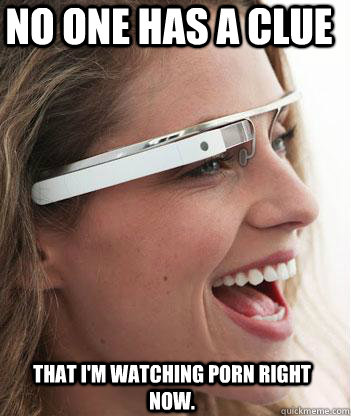
The introduction of the Google Glasses takes the separation problem with our devices to a whole new level. It’s easy to forget your phone in the other room, but it’s harder to forget your device when it’s strapped to your face. With Google Glasses you’re vulnerable to the temptation of mobile usage constantly, no matter what you’re doing. What’s interesting with Google Glass is how much privacy you have while using. Nobody can look over your shoulder to see what you’re watching or can tell you are filming them by the weird angle you’re holding your phone. I can see a lot of issues with Google Glass; it’s truly an innovative step forward into the future (or at least the idea of future we get from TV) and it will be interesting to see where it takes us. 

(http://i.qkme.me/3omz3t.jpg)

So what do you think? Do you pretend to text, fake phone calls and listen to music at the table? Is this what normal is? And if it is normal, does that make it okay?

-Carla.

Monday, 18 March 2013

Hi

Hi, welcome to my blog.

I hope you enjoy your stay,

-C