Tuesday, 23 April 2013

We’re watching (and commenting on) you.


-Social Media and its ability to be a tool for anti-corruption 

(http://data.whicdn.com/images/31135975/350x_large.jpg)
  
Social Media has this crazy ability, to spread news, and spread it fast. Whether that news be two people breaking up, the result of a reality tv show or suspected government corruption. Social media will spread it like wildfire.
(http://data.whicdn.com/images/44069319/406873_10152172996445942_701026845_n_large.jpg)

We no longer have to wait for the six o’clock news or the morning paper to see or hear about significant world events. The authorities are no longer able to keep things as quiet as they used to. All you need is one post to spark a worldwide debate. We can now share the things we’ve seen with the world, rather than just with those who are physically around us. This leaves no room for the government or authorities to hide if they’re doing the wrong thing. 


 This video, posted in March 2013, is a perfect example of this. After witnessing what they saw as police brutality, spectators began filming an altercation between an Officer and festivalgoer during Sydney’s Mardi Grais. The video quickly went viral, being shared throughout various social networking sites with large debates beginning in the comments. Its significance on social media propelled the incident to mainstream media for the rest of society to see.  The man involved in the altercation, Jamie Jackson had no intention of filing a report about the incident, but its popularity and impact on social media left the NSW police force with no other option than to launch their own investigation on the incident.

Social media gives strangers the opportunity to openly discuss and debate issues, giving participants and viewers the chance to hear augments foreign to those around them.

Henry Jenkins describes participatory culture as something that needs the consumers to act as produces (prosumers) who support the ease at which discussion can be created but also truly believe that their contribution stands for something and matters. Jenkins ideas of participatory culture links with the ultimate use of social media to fight corruption, Wikileaks. 

(http://data.whicdn.com/images/44944820/470x357-Czp_large.jpg)

Julian Assange and the Wikileaks project have come under major scrutiny since it’s realise of the ‘collateral murder’ video in 2010. The video shows a US chopper firing shots on a group of unarmed men in Baghdad, and later at a van of passers by who were trying to help the injured. Two innocent children on their way to school were also injured during this airstrike.
As Assange is known as the face of Wikileaks, this leads to many questions about who he is and what he stands for. Is Assange a whistle blower, hacker, hacktivist or terrorist? Augments have been made accusing Assange of being all these things.
A whistle blower is defined as someone who exposes wrongdoing in order to stop it. The term whistle blower comes with negative connotations, but what a whistle blower does, and what Assange did was for the greater good of humanity. Wrongdoing, especially within the government cannot be tolerated, and society needs whistle blowers. We need somebody to show us what’s happening, so we can process, discuss and form our own opinions. Yes, Assange is a hacker, but that also makes him a hacktivist. He uses the information he acquires to educate society about injustices taking place, not to intentionally damage national security. For that reason, it is unfair to label Assange as a terrorist. 
(http://25.media.tumblr.com/8f710309f5e31e3277e8d12864b8cd04/tumblr_mk8eo0Enia1qjrap6o1_250.jpg) 
 
 With the rise of videos and discussion of social and political injustices online, it seems as if Wikileaks sparked the beginning of a popular trend. People are becoming more willing to share their thoughts and opinions on issues online, and weather it be through the creation of more websites as complex and serious as Wikileaks or as simple as sharing and commenting on videos on Facebook, this trend will continue well into the future. The power of social media will only get stronger, and soon there wont be anywhere to hide your secrets.    

(http://b.vimeocdn.com/ts/320/027/320027069_640.jpg)

Wednesday, 17 April 2013

For every ‘share’ this post gets I will donate $1 to charity*


*That’s an outright lie.

It’s no secret that today’s society loves to find ways to make things easier for themselves. We have blankets with sleeves, dishwashers and can buy almost anything and get it delivered to our homes without even getting out of bed. 

It is then, no surprise that our laziness and love for staying in bed all day has brought about digital activism.

What is digital activism you ask? It’s the use of the interwebs, particularly social media, to lobby for change through a citizen movement. This is can be done in a variety of ways, from online petitions to Facebook pages.  You know that page you liked so that doctor would help the dying child? Yeah, that.

(http://readwrite.com/files/styles/800_450sc/public/fields/image.jpeg)

 There are a few issues I find with digital activism. It’s really easy to show your support, and that’s great. Just by changing your profile photo you can show the world how cultured and conscientious you are. But does that make us lazy?  Are we more than wiling to support something when all we have to do is click ‘like’ on a page, but give up when we’re called to actually leave our bedroom?

The Kony 2012 campaign is a perfect example of this.  Everybody I knew was sharing and liking the video, commenting on how wrong what was happening was. No matter how passionate their expressions were, I don’t know anyone who actually purchased the ‘action pack’ or took park in ‘cover the night’ despite how many Facebook events for it they created and joined.
Only 25 ‘activists’ of the 18,700 who clicked attending to a Sydney CBD Facebook event for ‘cover the night’ showed up, while ‘Kony 2012’ did not trend on Australian Twitter the day it was supposed to go viral. 

(http://www.geekosystem.com/wp-content/uploads/2012/03/kony-meme-2-298x550.png)

This is a major criticism of digital activism, labelling it as ‘slacktivism’ or ‘clicktivism.’
Did this happen because we, as a society are lazy? Do we think that just by simply clicking ‘like’ we are able to create social change?

 (http://i2.kym-cdn.com/photos/images/newsfeed/000/263/936/ca0.jpg)

Don’t get me wrong; I’m not against digital activism in any way.  Digital media, and social media in particular is a great way to get your message heard. I’ve signed online petitions against Internet censorship and joined Facebook groups in support of a cause. But sometimes it’s hard to tell legitimate pages from pages just fishing for ‘likes’ and popularity. 


I think people can be fooled on the Internet pretty easily.
(http://sophosnews.files.wordpress.com/2013/04/bill-gates-facebook.jpg?w=640)
The amount of times I've seen this image shared is proof of that.

Digital Activism works, but to a point. There comes a stage where society has to get up and voice their opinion IRL. Seeing 10,000 people show their support for something online doesn’t have the same effect as seeing 10,000 people standing together in the streets.
SLAM (Save Live Australian Music) is an organisation that has been making successful use of digital activism. The SLAM Facebook page is currently only has around 12,000 likes, they use it to create awareness for the SLAM day rally’s, events and petitions that surround the issues Australia is having with live music. The SLAM events and rallies have always had a great response.  In 2010 the SLAM rally saw between ten and twenty thousand people fill the streets of Melbourne. Each rally since then has amounted in similar results. SLAM can only be successful in its endeavors if people choose to get up and physically voice their opinion. Digital activism works, but at this point in time, it only works in conjunction with real life activism. 

So are you a digital activist? Are you constantly liking and sharing posts to show your support of a cause? And if so, do you actually follow up? 

Will digital activism become the only activism in the future? 

Its interesting,
-Carla.


Wednesday, 3 April 2013

Pretending to text to get out of awkward situations.

-->
(http://25.media.tumblr.com/1122d90567732ff5d96afb409c40896c/tumblr_mkm2ecxriL1rutfofo1_500.jpg) 

Being nineteen, I’d say that I can generally relate pretty well to my generations use of mobile devices. My phone battery died on the train home the other day and I thought I was going to die along with it.
 (http://data.whicdn.com/images/57291573/tumblr_midmyedo611s68qn6o1_500_large.gif)

Our phones not only help keep us entertained, but also give others the impression that we are far more busy and sociable than we actually are.  If I’m out waiting for a friend, I cant just stare into the distance, no, people might think I’m here alone, ill get out my phone to give everyone else the impression that I’m waiting for someone. If I want to avoid someone I’ve seen in the street, ill just whip my phone out and pretend to text, there’s even been times I’ve faked being on a phone call, just to get out of talking to someone.  But I do think that the use of mobile devices is becoming excessive, and I think the increase of use of social media plays a major role in this. With our phones always with us, we never are truly alone; at a touch on button (or a tap on a screen) I have access to an endless amount of people and am able to share my thoughts and opinions (no matter how pointless or strange) with the world.

"Twitter in real life" shows that in real life, nobody really cares. Check out the original here 


 But the use of mobile devices, especially as distractions has become something a little excessive. I work at a restaurant and the constant use of mobile devices at the table is always surprising. My mother would never allow me to have earphones in, listening to music, or playing with an iPad while having dinner; whether that be when we are out, or at home. I’ve seen young couples, awkward, on dates, who are on Facebook and Instagram under the table to bring themselves at ease.  Its like people cannot stand to be separated from their device.  Is our consistent use of technology making us less sociable? At times I think it is.

(http://data.whicdn.com/images/50987248/6354_482571615134008_1886397882_n_large.jpg)


(http://data.whicdn.com/images/56455853/tumblr_mk3gtgMext1s6uidoo1_500_large.jpg)
I have a friend who’s afraid of talking on the phone, because unlike text messaging, she cannot think about and construct her reply in the same way.

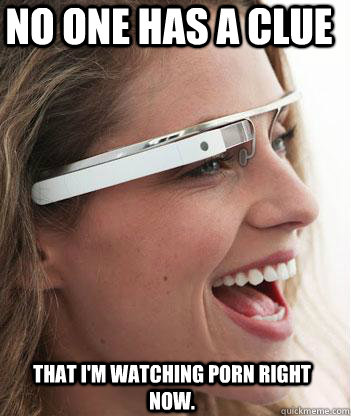
The introduction of the Google Glasses takes the separation problem with our devices to a whole new level. It’s easy to forget your phone in the other room, but it’s harder to forget your device when it’s strapped to your face. With Google Glasses you’re vulnerable to the temptation of mobile usage constantly, no matter what you’re doing. What’s interesting with Google Glass is how much privacy you have while using. Nobody can look over your shoulder to see what you’re watching or can tell you are filming them by the weird angle you’re holding your phone. I can see a lot of issues with Google Glass; it’s truly an innovative step forward into the future (or at least the idea of future we get from TV) and it will be interesting to see where it takes us. 

(http://i.qkme.me/3omz3t.jpg)

So what do you think? Do you pretend to text, fake phone calls and listen to music at the table? Is this what normal is? And if it is normal, does that make it okay?

-Carla.